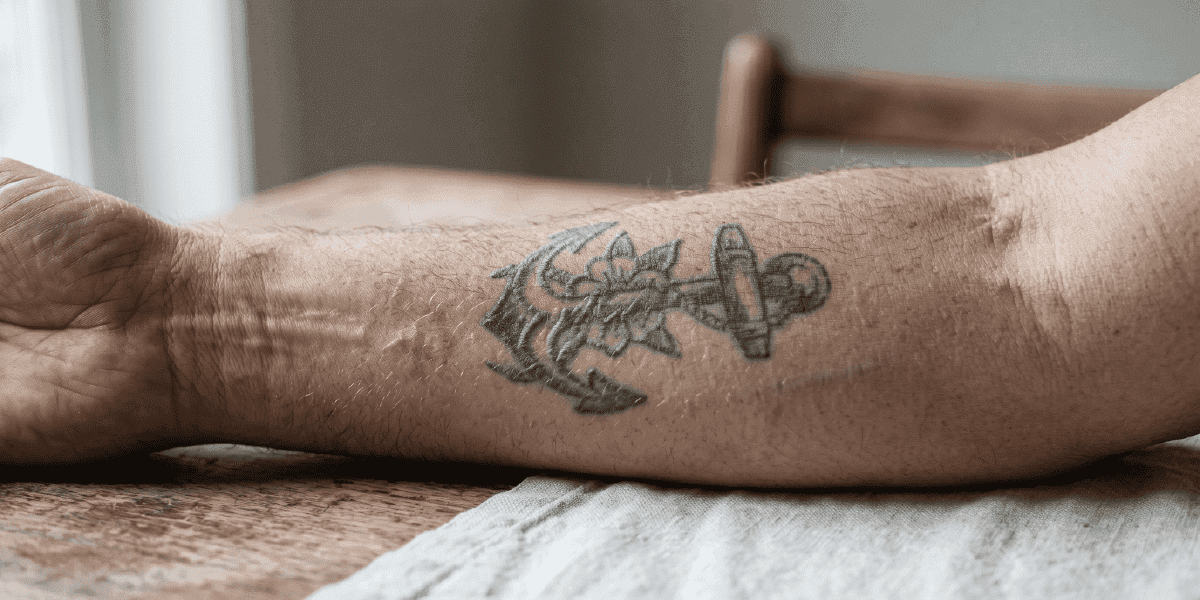
What actually causes scarring during laser tattoo removal, how to tell a real scar from normal healing firmness, and how to keep the risk close to zero.
By TattoosMap Editorial — July 2026
The Short Answer
Most people worry laser removal will trade a tattoo for a scar, but proper laser treatment rarely scars — it's built to reach the ink without damaging the surrounding skin. The real scarring risk lives around the laser rather than in it: aftercare mistakes like picking and sun exposure, excessive fluence from a careless tech, infection, and personal factors like keloid tendency or scarring that was already under the original tattoo. This covers what actually causes marks, who's genuinely at higher risk, and how to keep your odds of scar-free healing as high as possible.
DISCLOSURE: This post contains affiliate links. If you purchase through our links we may earn a small commission at no extra cost to you.
You want the tattoo gone, but the fear underneath the question is real: what if you trade the tattoo for something worse — a permanent scar where the ink used to be? It's the most common worry people bring to removal, and the honest answer is reassuring, with a few genuine caveats worth understanding.
Does Laser Removal Actually Scar?
For most people, done properly, no. Laser tattoo removal is specifically designed to break up ink while sparing the surrounding skin, and when it's done well by an experienced practitioner, the large majority of people heal with no lasting scar.
This is the core thing to understand: the laser itself is not a scarring tool by nature. It passes through the surface of the skin as light and delivers its energy to the ink pigment below, fragmenting it for your immune system to clear. The skin around and above the ink is largely bypassed. That targeting is the whole reason laser became the standard method — it reaches the ink without cutting, burning, or abrading the skin the way older removal methods did.
So scarring from laser removal isn't the default outcome. It's the exception, and it usually has a specific, often preventable cause.
HONEST LIMITATION
"Usually no scar" is the honest headline, but it's not "never," and it would be misleading to promise zero risk. Any procedure that affects the skin carries some possibility of scarring or pigment change, and a small number of people scar even with good treatment and good aftercare — particularly on certain body areas or with certain skin types. The realistic promise is that scarring is uncommon and largely avoidable, not that it's impossible. Anyone guaranteeing a scar-free result with total certainty is overselling.
What Actually Causes the Scarring
Here's the key insight: when scarring does happen, it's usually not the laser itself — it's something around the laser. The main causes are largely within your control or your clinic's.
Picking scabs and popping blisters. This is the single most common cause of self-inflicted scarring. Blisters and scabs after removal are normal, and they're sterile protective coverings your body built. Peeling or popping them exposes raw skin to infection and trauma, which is exactly what turns a clean heal into a scar.
Infection. An infected treatment site heals through inflammation and disorganised collagen — the raw material of a scar. Infection almost always follows picking, popping, or poor hygiene rather than the laser.
Laser removal works on a principle called selective photothermolysis. Ink particles absorb the laser wavelength far more strongly than the surrounding tissue does, and the pulse is shorter than the ink's thermal relaxation time — the window in which heat can conduct outward into neighbouring structures. A Q-switched pulse lasts nanoseconds and a picosecond pulse a thousand times less than that, so the energy shatters the particle and dissipates before collagen bundles, fibroblasts and vasculature register meaningful heat. That's the whole reason removal doesn't scar by default.
Scarring begins when that containment fails. Excessive fluence, too many overlapping passes, or repeat treatment before the previous injury resolved allows heat to spread into the dermis, and full-thickness epidermal loss from a popped blister exposes the dermis directly. Either route triggers fibroblasts into aggressive repair mode, laying down dense, poorly aligned type III collagen that never fully remodels into the organised type I lattice of normal skin. That disorganised bundle is what a scar physically is. Picture a controlled demolition where the charges are timed to drop one building without touching its neighbours — get the timing wrong and the block goes with it.
SHARE THIS
"Fewer than 5 percent of properly performed laser removals scar, but nearly every case that does traces back to a popped blister, an overheated setting, or scar tissue that predated the first session."
Exactly What To Do, Day by Day
01
BEFORE SESSION 1: THE CONSULTATION THAT PREVENTS SCARS
Run your fingertips across the tattoo in good light and feel for raised lines, firm patches or areas where the linework sits proud of the skin. Ridged texture you can feel through the ink means fibrosis is already present and will be visible once the pigment clears. Pre-existing texture under a tattoo is normal and extremely common, particularly on heavy blackwork and cover-ups; a technician who won't examine or discuss it is not. Tell them about any keloid history, any tattoo that healed badly, and any medication like isotretinoin in the last six months. Don't accept a treatment plan built on how fast you want it done rather than how your skin responds.
02
SESSION 1: WATCHING THE FROSTING
Frosting should appear as an even chalk-white layer across the treated area, fading to red over 20 to 30 minutes. It stings hot and sharp on the surface. Uniform white frost and surface-level sting are normal; grey or blue-black discolouration, immediate pinpoint bleeding, or a deep dull ache underneath rather than a sharp surface pain is not — those signal energy penetrating past the ink into the dermis. Speak up during the session if the pain changes character, because a technician can drop the fluence mid-treatment. Don't let anyone tell you a more punishing session clears more ink, because it doesn't — it just adds heat.
03
DAY 2-5: THE BLISTER DECISION
Blisters appear over the densest ink, tense and filled with clear or blood-tinged fluid, sometimes the size of a grape. They feel tight and tender but the surrounding skin stays soft. Intact blisters of any size confined to the treated area are normal and are not a burn; blisters extending well past the tattoo outline, or skin that has sloughed off leaving a raw wet surface, is not. Cover them with a loose dry non-adherent dressing and leave them completely alone. Don't drain, pop or trim them — the blister roof is a sterile biological dressing over exposed dermis, and removing it is the single most common cause of removal scarring.
04
What To Never Use
Popping, draining or trimming blisters
the intact roof is a sterile barrier over exposed dermis, and breaching it converts a contained laser response into a full-thickness open wound that heals by disorganised fibroblast deposition, which is the direct mechanism of removal scarring
Sessions spaced closer than eight weeks apart
treating skin whose collagen is still in the disorganised type III phase stacks thermal injury onto unfinished repair, and fibroblasts respond to repeated insult with progressively denser scar tissue
Sun exposure on healing skin
UV drives inflammation and melanin production in tissue already remodelling, prolonging the fibroblast-active phase and forcing lower laser fluence next session, which means more total sessions and more cumulative trauma
Isotretinoin within six months of a session
it suppresses sebaceous function and alters wound-healing behaviour, and treating skin on or recently off it carries a documented risk of atypical scarring that no laser setting compensates for
Chasing 100 percent clearance on a stubborn area
repeat aggressive passes on ink that has plateaued deliver heat to tissue with no remaining target to absorb it, and the last 10 percent of fade is where most self-inflicted scarring happens
Frequently Asked Questions
Rarely, when it's done properly. The laser targets ink pigment specifically and doesn't damage the collagen structure that makes scars. When scarring does happen it's usually traceable to a popped blister, settings run too hot, sessions booked too close together, or scar tissue that the original tattoo was already hiding. The technology isn't the risk — the process around it is.
Timing and behaviour. Normal post-treatment firmness is uniform across the whole treated shape, softens progressively, and is largely resolved by month six to twelve. A scar is discrete, resists pressure, and either holds steady or thickens over the same period. If it's still getting firmer at month four, treat it as a scar and act.
Yes, and this is the most common version of "the laser scarred me." Deep or repeatedly worked linework damages the dermis at the time of tattooing, and the ink sitting on top conceals the texture. Clear the ink and the fibrosis underneath becomes visible for the first time. Feeling raised lines through your tattoo before you start is a strong hint this will happen.
Indirectly, yes. Topical anaesthetic removes the pain feedback that tells a technician they're running too hot, and vasoconstrictor-containing formulations reduce blood flow to the treatment site. Neither is a reason to refuse numbing outright, but the technician needs to know you're using it so they can adjust settings and watch the tissue response rather than your reaction.
Silicone gel sheeting is first-line and works best on scars under six months old. Beyond that, options include intralesional corticosteroid injection for hypertrophic and keloid tissue, and fractional laser resurfacing for texture. All of it belongs with a dermatologist, not the removal clinic — different equipment, different training, different goal.
Discussion (0)
Verified Accounts
No public comments yet.
TATTOOSMAP VERIFIED CLINICS
Ready To Start?
Get a free consultation quote from a verified removal clinic. No commitment, just a real price for your specific tattoo.
Excessive fluence. A tech running the laser too hot, chasing faster clearance, causes more heat damage to the surrounding skin and raises scarring risk. This is a clinic-skill issue, and it's why the operator matters as much as the machine.
Sun exposure during healing. Healing skin exposed to UV pigments unpredictably and heals worse, contributing to both discolouration and scarring.
Your own biology. Some people simply scar more readily, covered below.
HONEST LIMITATION
The most reassuring and the most sobering fact are the same one: most scarring is preventable, which means most of it comes down to choices — the clinic's fluence and your aftercare. That's reassuring because it means you have real control. It's sobering because it means cutting corners genuinely raises your risk. Choosing a skilled clinic and following aftercare properly isn't box-ticking; it's the actual difference between a scar-free result and a mark, in the cases where it goes wrong.
Who Is Genuinely at Higher Risk
Some factors raise the baseline risk regardless of how well the removal is done, and it's honest to name them.
A history of keloid or hypertrophic scarring. If you scar aggressively — raised, spreading scars — you carry a higher risk with any skin procedure, including removal. Tell your practitioner before you start.
Fitzpatrick IV–VI (deeper skin tones). The main risk here is pigment change — hyperpigmentation or hypopigmentation — more than true scarring, and it's usually managed with the right wavelength (1064nm) and conservative treatment. Still, it deserves an experienced practitioner.
Certain body areas. Chest, shoulders, upper back, and ankles tend to scar more readily than forearms and other flatter, less mobile areas.
Poor circulation, diabetes, or smoking. Anything that slows healing raises the time the skin is vulnerable and the chance of a poor outcome.
HONEST LIMITATION
For keloid-prone skin specifically, this is worth a genuine conversation with a dermatologist before starting, rather than glossing over it. Keloid formers face a real, elevated risk, and while removal is often still possible, it should be approached cautiously, conservatively, and with medical input. A responsible clinic will ask about your scarring history at consultation and adjust accordingly. If they don't ask, that tells you something about how carefully they're treating you.
The Pre-Existing Scar Nobody Warns You About
Here's a scenario that catches people out and gets blamed on the laser wrongly: the scar that was already there.
When a tattoo is applied — especially by an amateur, or heavily worked, or reworked over an old piece — the tattooing process itself sometimes leaves scarring under the ink. You couldn't see it, because the ink covered it. As the laser clears the pigment, that pre-existing scar is revealed, and it looks exactly as though the removal caused it.
It didn't. The scar was there all along, hidden beneath the tattoo. The removal simply uncovered what the original tattooing left behind.
HONEST LIMITATION
This is genuinely hard to know in advance, and it's fair to set the expectation honestly: if your tattoo was heavily worked, amateur, or a cover-up, there's a chance some scarring underneath will become visible as the ink clears, and no clinic can fully predict it beforehand. This isn't the removal failing or the laser scarring you — it's the reveal of damage that was already present. A good practitioner may flag the possibility if the tattoo looks heavily worked, but nobody can see through ink to the skin beneath until it's cleared.
How to Keep Your Scarring Risk as Low as Possible
Most of what protects you is straightforward, and it stacks the odds heavily in your favour.
Choose a skilled, experienced clinic — proper fluence and technique are the biggest clinic-side factor. Ask to see healed results.
Never pick scabs or pop blisters — the single most important thing in your control, and the most common cause of self-inflicted scarring.
Follow aftercare properly — keep it clean, moisturised, covered while healing, and out of the sun. Our aftercare protocol covers the full routine.
Space sessions properly — the full 6 to 8 weeks lets skin fully recover between treatments, and rushing stacks trauma.
Protect it from the sun through the whole course, not just the healing window.
Tell your clinic your history — keloids, easy scarring, slow healing, so they can treat conservatively.
Don't smoke through the course — it slows healing and raises risk alongside reducing clearance.
HONEST LIMITATION
Even doing everything right, a small residual risk remains, and if you do end up with a mark despite good care, that isn't necessarily a failure on your part or the clinic's — it's the baseline risk any skin procedure carries. If scarring does occur, it's often treatable in its own right, with options from silicone gels to further dermatological treatment. The goal isn't a guarantee, which nobody can honestly give; it's stacking every controllable factor in your favour so the odds of a clean result are as high as they can be.
Think of laser removal like carefully lifting a stain out of fabric versus scrubbing it out. The gentle, targeted approach — the laser done well, healed properly — lifts the ink while leaving the fabric intact, and most of the time you'd never know anything was there. The scrubbing — picking, popping, infection, a heavy hand — is what damages the weave. The tool isn't the danger. How it's used, and how you treat it afterward, is what decides whether the fabric comes through clean.
Crusts form as blisters deflate — honey-coloured or dark, tightly adhered, often across the whole treated shape. The itch is deep and nerve-level rather than surface, and it peaks around day seven when people are least supervised and most likely to pick. Firm adhered scabs and severe itching are normal; a scab that stays wet, lifts to reveal a bleeding base, or sits in an area of increasing pain is not. Keep the area moisturised with plain unscented ointment and take an oral antihistamine at night. Don't pull at a scab even when it's attached at one edge only, because that edge is anchored to new epidermis that isn't finished yet.
05
WEEK 3-8: TEXTURE THAT ISN'T A SCAR YET
New skin is pink, shiny and noticeably firmer than the tissue around it, sometimes slightly raised across the whole treated shape. It feels tight when you stretch the area and hypersensitive to heat and sun. Uniform firmness with a smooth surface is normal early collagen — this is remodelling, not scarring; a discrete raised cord or nodule that stands proud of everything around it and continues thickening week on week is not. Use SPF 50 daily and keep the area moisturised. Don't start scar treatment yet, and don't book your next session until the firmness has softened, because treating actively inflamed tissue compounds the injury.
06
MONTH 3-6: SEPARATING SCAR FROM REMODELLING
Genuine scarring declares itself here. A true hypertrophic scar is raised, firm, confined to the treated boundary and often pink or shiny; normal remodelling is flattening and softening on the same timeline. Press it — remodelling tissue gives, scar tissue resists. Gradual softening and flattening are normal; anything still thickening at month four, or extending beyond the original treated area, is not and suggests keloid formation. If it's genuinely raised at month four, start silicone gel sheeting now, since it's most effective on immature scars. Don't wait to see if it settles past month six, because the window where scar treatment works well is closing.
07
MONTH 6-24: THE PERMANENT RESULT
What remains at this point is what you keep. Most people end with skin that's marginally shinier or paler than its surroundings and no palpable texture change. It feels like normal skin. Faint tonal difference with normal texture is the normal end state; a raised firm ridge tracing the original linework is not — and if it follows the tattoo's outlines exactly, it's almost certainly the original artist's scarring rather than the laser's. Get any persistent raised tissue assessed by a dermatologist rather than the removal clinic, since they treat scars and the clinic doesn't. Don't accept "give it more time" at the two-year mark, because remodelling is finished.