DISCLOSURE: This post contains affiliate links. If you purchase through our links we may earn a small commission at no extra cost to you.
Clinics quote you per session because per session sounds affordable. Nobody advertises the total, and the total is the only number that matters.
Run Your Numbers First
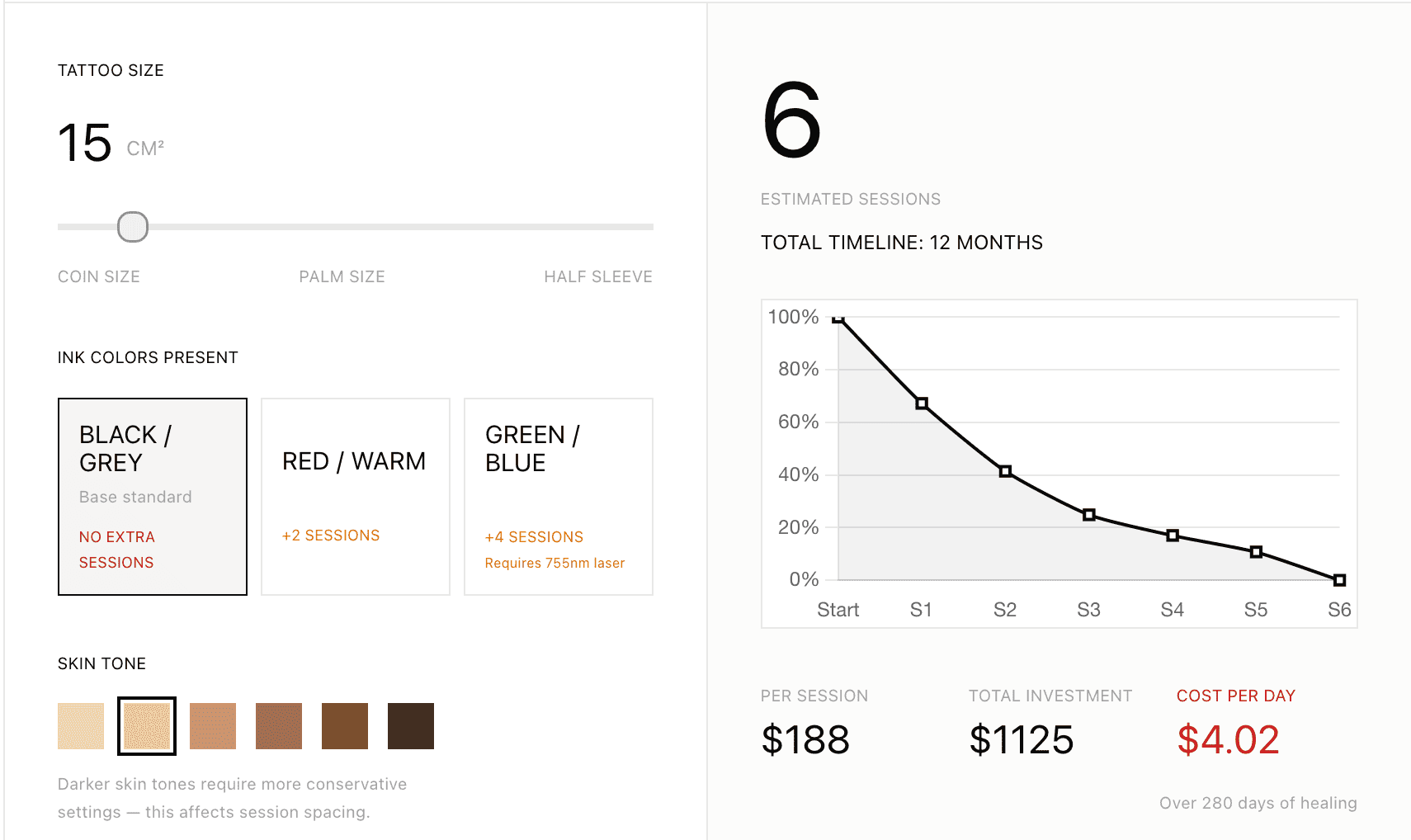
The calculator below takes your tattoo type, size, colors, location, and skin type and gives you a total cost range — not a per-session teaser.
[CALCULATOR EMBEDS HERE]
Got your number? Good. Now here's what it can't account for, and where people get surprised.
What Drives the Total — And It Isn't Session Price
Total cost is session price multiplied by session count, and session count has far more spread than price does. Price varies maybe 4x across clinics. Session count varies 5x across tattoos. The count wins.
A worked example, same tattoo, two clinics:
- Budget Q-Switch: $120 per session × 12 sessions = $1,440
- Premium PicoWay: $280 per session × 7 sessions = $1,960
The pico costs $520 more and finishes five months sooner with less scarring risk. That's a real decision. But flip the tattoo to something with green in it:
- Budget Q-Switch: $120 × 18 sessions, green still not clearing = $2,160 and a failure
- PicoSure at 755nm: $300 × 9 sessions = $2,700 and it's gone
Now cheap is more expensive. This is the trap — the low per-session price attracts people whose ink specifically needs the machine that clinic doesn't own.
Any calculator, including ours, is working from population averages and it doesn't know your immune system. Two people with identical inputs can land four sessions apart. Treat the output as a budgeting range, not a quote — and if it comes back at $2,400, plan for $2,900.
Typical Price Ranges
Per session, by size:
- Tiny — under 2 inches: $75 to $150
- Small — palm-sized: $150 to $250
- Medium — hand to forearm: $200 to $350
- Large — half sleeve, back panel: $350 to $500
- Full sleeve or back piece: often priced hourly, $400 to $800
Modifiers that move those numbers:
- Picosecond device: add 20 to 40% per session, subtract sessions from the total
- Major metro: add 30 to 50% over regional pricing
- Package pricing: typically 10 to 20% off, with a catch we'll get to
- Consultation and patch test: $0 to $100, often credited toward session one
Total cost by tattoo type, which is the number you should actually plan against:
- Small amateur black: $400 to $900
- Professional black, medium: $1,600 to $3,600
- Professional multicolor: $2,800 to $6,300
- Cover-up: $4,000 to $8,000+
- Fading for a cover-up only: $500 to $1,500
Those ranges assume you finish. A large share of people don't — they stall at the session-four plateau, stop paying, and end up having spent $800 on a tattoo that's now a faded grey ghost instead of a tattoo. Partial spend on a removal is the worst financial outcome available, because it buys you a result nobody wants. Budget for the whole thing or don't start.
The Hidden Costs Nobody Quotes
Your total isn't just sessions. It's everything the treatment drags along with it.
Numbing. Topical lidocaine runs $20 to $40 a tube and you'll use one every session or two. Some clinics charge $25 to $75 for injected lidocaine or a Zimmer cooling unit. Over twelve sessions that's $300 to $900 nobody mentioned at consultation.
Aftercare. Ointment, non-stick dressings, mineral sunscreen for the healing window. Call it $15 to $30 per session, $200 to $400 across a full course.
Time and travel. Twelve sessions at 6 to 8 weeks apart is 14 to 18 months of appointments. If you're driving 45 minutes each way or taking a half day off work, that's a real line item — often the largest hidden one.
Restarting somewhere else. People switch clinics mid-course more than you'd think, usually after the plateau. The new clinic won't honor your old package and you often lose whatever sessions you prepaid.
The one hidden cost worth paying is numbing. People try to tough it out to save $30, quit at session four because it hurts, and lose the entire investment. Pain is the number one reason people abandon a course mid-way. Thirty dollars a session to actually finish is the best money in this whole breakdown.
Where the Money Gets Wasted
Prepaid packages. A 10-session package at 15% off looks like a deal. It's a price point, not a prognosis — and it locks you to one device before anyone knows if that device can clear your ink. If you need 16 sessions, you're paying full freight for six more. If the clinic can't clear your green, you've prepaid ten sessions to find that out.
Buying on per-session price alone. Covered above. The cheapest chair is frequently the most expensive total.
Paying for full removal when you want a cover-up. This is the big one. If your actual goal is a new tattoo over the old one, you need fading — 3 to 5 sessions — not removal. That's $500 to $1,500 instead of $3,000. Say the words "fading for a cover-up" at consultation and watch the quote change.
Removal creams. Zero. They don't reach the dermis. Any money here is money burned.
Packages aren't always a scam. If you've completed two sessions, you know your clearance rate, and the clinic has the right device for your ink — a package on the remaining sessions is legitimately good value. The problem is buying one at consultation, before anyone knows anything. Buy packages at session three, never at session zero.
How to Actually Reduce Your Total
- Get a pico consultation even if you plan to use Q-Switch. The session-count difference tells you which is cheaper overall.
- Ask about fading pricing specifically. Most clinics have it and most don't offer it unprompted.
- Stop smoking for the course. Not a lifestyle lecture — smokers had roughly a 70% lower chance of clearance at ten sessions in one study. That's several thousand dollars of extra sessions.
- Wait the full 6 to 8 weeks between sessions. Going early wastes a paid session on ink your body hasn't finished clearing.
- Buy numbing yourself. Clinic markup on topical lidocaine is significant and the pharmacy version is identical.
Think of it like buying tires. The cheap set costs less at the counter and more per mile, and you don't find out which one you actually bought until you're 30,000 miles in and shopping again. Tattoo removal is the same trade — the price on the sign and the price of the outcome are two different numbers, and only one of them is yours to pay.
Related Removal Guides
- Laser Comparison: Compare pulse mechanisms in our PicoWay vs PicoSure vs Q-Switch Guide.
- Budget & Estimations: Calculate total sessions with our Tattoo Removal Cost Calculator.
- Post-Laser Healing: Read what to expect in our Laser Tattoo Removal Blister Care Guide.
The Biology of Tattoo Healing
The cost of removing a tattoo is really the cost of how many sessions your immune system needs. The laser does not remove ink — it shatters it. Your body does the actual removal. Every time a laser pulses over your tattoo it breaks ink particles into microscopic fragments. White blood cells called macrophages then engulf those fragments and carry them away through the lymphatic system. That filtration process takes 6 to 8 weeks per session — which is why sessions cannot be stacked close together. Your body needs time to clear what the previous session shattered before the next one adds more. Your immune system can only process a finite amount of shattered ink per cycle. That biological ceiling is the single biggest driver of your total session count — and therefore your total cost. Clinicians use tools like the Kirby-Desai scale to estimate sessions before treatment begins. The scale weighs six variables: skin tone, ink density, tattoo layering, location on the body, ink colours, and whether the work is a cover-up over existing ink. Location matters more than most people expect. Tattoos on hands, feet, and ankles are further from the lymph nodes that process the debris. Reduced blood circulation in the extremities means slower clearance and more sessions. A wrist tattoo can take 30% more sessions than the same tattoo on the upper arm. Dense tattoos, cover-ups, and ink packed in multiple layers are the highest-cost scenarios. Not because the laser works differently but because there is simply more material for your immune system to clear.
"A $120 session at the wrong clinic can cost you $2,160 and still leave the green in your tattoo — cheap per session is not cheap."
What To Never Use
Buying a prepaid package at consultation
it's a price point dressed as a prognosis, and it locks you to one device before anyone knows whether that device can clear your ink.
Choosing a clinic on per-session price alone
session count varies 5x across tattoos while price varies about 4x across clinics, so the count decides your total, not the sticker.
Skipping numbing to save $30 a session
pain is the number one reason people abandon a course, and quitting at session four wastes everything already spent.
Paying for full removal when you only want a cover-up
fading is 3 to 5 sessions instead of 12, and most clinics won't offer that pricing unless you ask for it by name.