DISCLOSURE: This post contains affiliate links. If you purchase through our links we may earn a small commission at no extra cost to you.
You went in for a fifteen-minute laser session and eight hours later there's a fluid-filled dome the size of a coin on your arm. Nobody warned you, and now you're googling at midnight wondering if something went badly wrong.
Nothing went wrong. This is the part they mention on the consent form and never say out loud.
What a Blister Actually Means
The laser fires energy into your dermis and your ink absorbs it. That energy shatters the pigment — and some of it inevitably transfers as heat into the surrounding tissue, which triggers an inflammatory response. Your body floods the area with fluid, and where the epidermis separates from the dermis underneath, that fluid pools into a blister.
So a blister is evidence the laser reached the right depth at sufficient energy. No blistering at all isn't automatically bad, but combined with no frosting during the session, it can mean your fluence is too low or the wavelength is wrong for your ink.
What's normal:
- Timing: 8 to 24 hours after the session, occasionally within the first few
- Size: anywhere from pinpoint to several centimetres across
- Fluid: clear, straw-yellow, or lightly blood-tinged
- Count: one large blister or a cluster of small ones, both normal
- Duration: they usually drain or reabsorb within 3 to 7 days, with full closure by 10 to 14
Bigger tattoos blister more. First sessions blister more than later ones. Denser black ink blisters more than sparse work, because there's more pigment absorbing more energy in the same square centimetre.
Clinics genuinely undersell this. Blisters appear in the consent paperwork you signed without reading and almost never in the conversation, so a large share of people spend their first night convinced they've been burned or botched. You haven't — but the silence is a real failure of the consultation, and if your tech didn't mention blistering before your first session, ask them what else they skipped.
Normal Blister vs Actual Problem
Most blisters need nothing but time. A small number need a phone call. Here's the line.
Normal, leave it alone:
- Clear or straw-coloured fluid
- Mild redness confined to the treated area
- Warmth and tenderness for 24 to 48 hours
- Blood-tinged fluid — looks worse, means nothing
- Blister breaks on its own and the skin stays as a covering
Call the clinic:
- Redness spreading outward past the treated area, especially in streaks
- Thick, opaque, yellow-green fluid or pus — clear-yellow is fine, cloudy is not
- Fever or chills at any point
- Pain increasing after day three rather than steadily decreasing
- New blisters forming after day two — the reaction should be done by then
- Blisters still present past two weeks
- Deep purple or black tissue at the base
Infection is uncommon but real, and it's almost always caused by picking, popping, or an unclean dressing rather than by the laser itself.
Blood-filled blisters look frightening and they're usually fine — small capillaries rupture under the same energy that fragments your ink. But blood blisters do carry a marginally higher scarring risk than clear ones, and they suggest the fluence ran hot for your skin. Mention it at your next appointment and ask your tech to dial it back slightly. A good one will.
What To Do — And What Not To
Do:
- Leave it intact. Unbroken blister roof is a sterile biological dressing and nothing you buy beats it.
- Keep it clean with mild soap and water. Pat dry, don't rub.
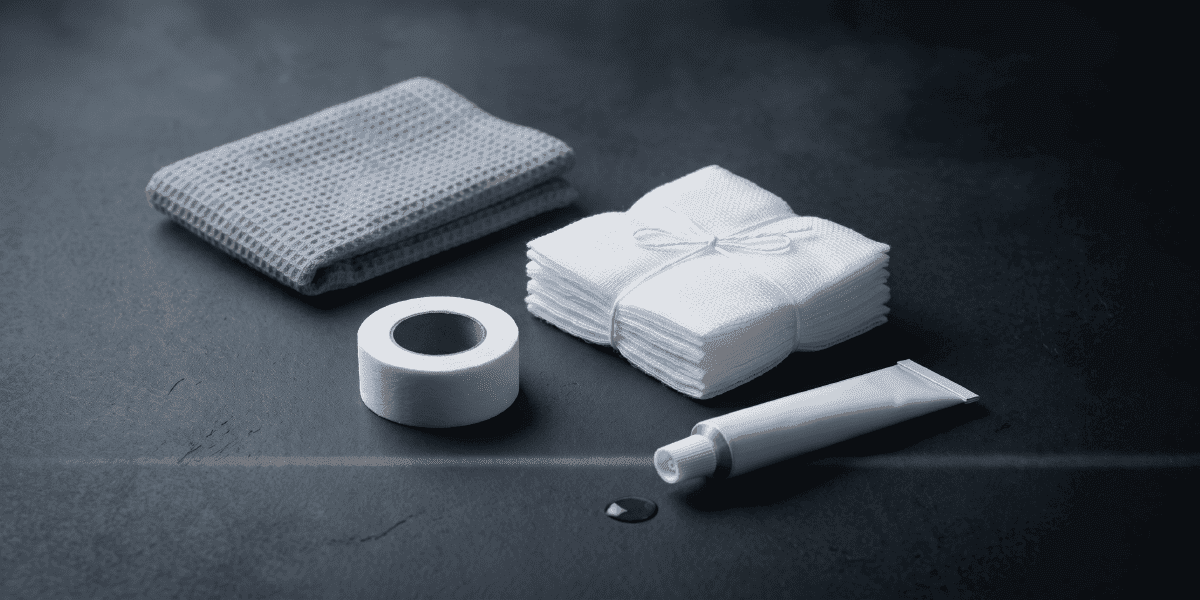
- Cover it with a non-stick pad and paper tape, changed daily.
- Thin layer of ointment — plain petrolatum or whatever your clinic supplied. Thin, not packed on.
- Cool compress over cloth for the first day if it throbs. Never ice directly on skin.
- Elevate if it's on a limb — reduces swelling and pooling.
- Let it drain naturally and leave the deflated skin in place as a covering.
Don't:
- Pop it. Not with a pin, not with a sterilised needle, not "just a small hole to relieve pressure." This is the mistake that scars people.
- Pick the skin off once it's drained. That flap is protecting the wound underneath.
- Peel scabs as they form.
- Soak it — no baths, pools, hot tubs, or open water until fully closed.
- Apply antibiotic ointment unless your clinic told you to. Neosporin causes contact dermatitis in a meaningful number of people and there's no infection to treat yet.
- Expose it to sun. Healing skin pigments unpredictably and you'll be left with a mark outlasting the tattoo.
- Work out hard for 48 hours — sweat, friction, and heat all aggravate it.
People pop blisters because the pressure is genuinely uncomfortable and because a large blister on a visible spot is embarrassing. That's understandable and it's still the wrong call. A popped blister exposes raw dermis to bacteria and mechanical trauma, which is precisely the recipe for the textural scarring you were trying to avoid by removing the tattoo. If one is so large and tense you can't function, call the clinic and let them drain it properly with sterile technique — don't do it yourself at the bathroom sink.
Do Blisters Mean You'll Scar?
Usually not. A blister that's left alone and heals closed generally leaves nothing behind.
Scarring risk climbs sharply with three things: popping or picking, infection, and repeated blistering at excessive fluence session after session.
Some things that raise your baseline risk regardless:
- Keloid or hypertrophic scarring history — tell your tech before session one, not after
- Fitzpatrick IV–VI — higher hyperpigmentation risk, which is different from scarring but reads the same in the mirror
- Poor circulation, diabetes, or smoking — slower closure means more time exposed
- Tattoo location — chest, shoulders, and upper back scar more readily than forearms
What you'll often see instead of a scar is temporary pigment change. Hypopigmentation — a pale patch — usually returns to normal over 6 to 12 months. Hyperpigmentation — a darker patch — is common on deeper skin tones and typically fades over a similar window, faster if you keep it out of the sun.
If you're blistering severely at every single session, that's a fluence conversation, not a normal course. A tech chasing faster clearance by running hot gets more dramatic blistering and marginally faster results in exchange for real scarring risk. That trade isn't yours to make unknowingly. Ask directly what fluence they're using and whether it's changed — if the answer is defensive rather than specific, that tells you something.
When Blisters Show Up in the Session Arc
Blistering isn't constant across your course, and knowing the shape helps.
Sessions 1–2: Heaviest blistering. Maximum intact pigment absorbing maximum energy, and your skin hasn't adapted. This is when people panic.
Sessions 3–5: Usually less. Fluence may increase but there's less ink to absorb it. Some people stop blistering entirely here, which is normal and doesn't mean it's stopped working — this phase looks stalled from the surface anyway.
Sessions 6+: Variable. If your tech increases fluence as pigment thins, blistering may return briefly.
Final sessions: Minimal. Little pigment left to absorb energy.
If you blister hard at session nine after nothing at sessions five through eight, ask what changed. Usually it's a fluence increase, which is often the right call — but you should know it happened.
Blistering intensity is not a progress indicator and people read it as one in both directions. Someone who stops blistering at session four concludes the laser isn't working. Someone blistering heavily at session seven concludes it's working brilliantly. Neither inference holds. Judge progress with your before-session photographs under consistent lighting, not by the drama of your skin's reaction.
Think of it like a bruise from a hard tackle. The bruise tells you contact was made. It doesn't tell you whether you won the ball, and the size of it says more about your capillaries than about how well you played. Your blisters mean the laser connected. What actually cleared is a question only your photos answer.
Related Removal Guides
- Laser Comparison: Compare pulse mechanisms in our PicoWay vs PicoSure vs Q-Switch Guide.
- Budget & Estimations: Calculate total sessions with our Tattoo Removal Cost Calculator.
- Post-Laser Healing: Read what to expect in our Laser Tattoo Removal Blister Care Guide.
WHY HEAT SEPARATES EPIDERMIS FROM DERMIS
A blister forms at a specific anatomical seam — the dermal-epidermal junction, the layer where your outer skin anchors to the living tissue beneath it. When the laser pulse hits your ink, most of the energy converts to a photoacoustic shockwave that shatters the pigment particle, but a fraction always escapes as heat into the surrounding tissue. That thermal spill damages the anchoring structures at the junction, and your body responds by flooding the area with plasma and inflammatory fluid. With the anchor points weakened, the fluid has somewhere to go: it collects in the space between epidermis and dermis and lifts the outer layer away as a dome. That's your blister. It's a separation, not a burn through the skin, which is why the roof stays intact and why what's underneath is still living tissue rather than an open wound. This is also why the blister roof matters so much. That detached layer of epidermis is sterile, permeable to gas, and sitting in exactly the position your body needs it — it functions as a biological dressing while the junction underneath rebuilds its anchoring proteins over roughly seven to ten days. Remove it and you expose the raw dermal surface directly to bacteria, friction, and dehydration, and the healing process shifts from clean re-epithelialisation to inflammatory repair. Inflammatory repair is what lays down disorganised collagen, and disorganised collagen is what a scar physically is. The blister isn't the scarring risk. Opening it is.
"The blister isn't what scars you — opening it is, because that detached skin is a sterile dressing your body built in eight hours."
Exactly What To Do, Day by Day
LEAVE THE BLISTER COMPLETELY INTACT
Do not pop, drain, or pierce it for any reason, including pressure or appearance. The unbroken roof is a sterile dressing and nothing you can buy performs better.
CLEAN GENTLY ONCE OR TWICE DAILY
Mild soap and lukewarm water, then pat dry with a clean towel. No rubbing, no scrubbing, no antiseptic wipes.
COVER WITH A NON-STICK PAD CHANGED DAILY
Apply a thin layer of plain petrolatum first so the dressing lifts without pulling. Skip antibiotic ointment unless your clinic specifically told you to use it.
LET IT DRAIN ON ITS OWN AND LEAVE THE SKIN IN PLACE
When a blister breaks naturally, do not trim or peel away the deflated skin. It stays as a protective covering until it separates by itself.
KEEP IT OUT OF SUN AND WATER UNTIL FULLY CLOSED
No pools, baths, hot tubs, or direct sun for the full ten to fourteen days. Healing skin pigments unpredictably and sun exposure during this window leaves a mark that outlasts the tattoo.
What To Never Use
Popping a blister to relieve pressure
it exposes raw dermis to bacteria and friction, which shifts healing from clean re-epithelialisation to inflammatory collagen deposition, and that is what a scar physically is.
Peeling the deflated skin after a blister drains naturally
that flap is still functioning as a dressing over tissue that hasn't rebuilt its anchoring proteins yet.
Applying antibiotic ointment by default
Neosporin causes contact dermatitis in a meaningful share of people, and there is no infection present to treat in a normal blister.
Judging your progress by how much you blistered
blistering reflects fluence and pigment density, not clearance, so use before-session photographs under consistent lighting instead.