Can You Get a Tattoo Over a Scar? What's Possible and What Isn't
Usually yes, once the scar is mature — but type and timing decide how ink takes. Which scars work, how long to wait, and why keloids need caution.
By TattoosMap Editorial — August 2026
The Short Answer
Yes, most scars can be tattooed once they're fully healed and mature — usually at least 1 to 2 years old — and flat, faded scars take ink best. Raised keloid scars, very thin or shiny scars, and anything still pink, tender, or changing should be approached with caution or avoided, and keloid-prone skin risks a new keloid from the tattooing itself. Because scar tissue holds ink unpredictably, this is specialist work: choose an artist experienced specifically with scars, expect possible touch-ups, and get a doctor's opinion first for significant or medical scars.
DISCLOSURE: This post contains affiliate links. If you purchase through our links we may earn a small commission at no extra cost to you.
People come to scar tattooing for good reasons — covering a surgical line, reclaiming a self-harm scar, turning a burn or an accident mark into something they chose. The good news is it's usually possible. The honest part is that scar tissue is a different material to tattoo, and whether it works depends on the scar, the timing, and above all the artist.
Can It Be Done? Mostly Yes — With Conditions
For most scars, the answer is yes, once conditions are met. But "a scar" covers a huge range of tissue, and the type matters enormously.
Scars that generally tattoo well:
Flat, faded, mature scars — these are the best candidates, taking ink most like normal skin
Old surgical scars that have flattened and softened over years
Faded stretch marks — technically a form of scarring, and often tattooable
Well-healed flat scars from accidents or minor burns
Scars that are trickier or riskier:
Raised or keloid scars — hard to tattoo evenly, and keloid-prone skin risks forming a new keloid from the tattoo needles themselves
Very thin, shiny, or stretched scars — fragile tissue that may not hold ink well or could be damaged
Deep or uneven textured scars — the surface irregularity distorts the design
Recent, pink, tender, or still-changing scars — not ready, full stop
HONEST LIMITATION
No artist can promise exactly how a scar will take ink until they actually work on it, and it's honest to say the result on scar tissue is less predictable than on normal skin. Scar tissue can absorb ink differently across a single scar, hold colour unevenly, or spread ink in ways healthy skin wouldn't. A good scar artist will tell you this upfront and may suggest a small test area first. Anyone guaranteeing a flawless result on scar tissue is overselling — the realistic promise is a skilled attempt with a strong likelihood of a good outcome, often needing a touch-up, not a certainty.
The Timing: Wait Longer Than You Think
WHY SCAR TISSUE HOLDS INK DIFFERENTLY
## Why Scar Tissue Holds Ink Differently From Normal Skin
Scar tissue is structurally different from normal skin in almost every way that matters for tattooing.
### How Normal Skin Is Built
Undamaged skin has an organised structure — collagen fibres arranged in a basketweave pattern, a consistent blood supply, and the normal layering of epidermis and dermis that gives skin its uniform elasticity and texture.
### What Happens When Skin Scars
When the body repairs a significant wound, it prioritises speed and strength over restoring that architecture. It lays down collagen in dense, parallel, disorganised bundles.
The result is tissue that differs from normal skin in every way that matters for tattooing:
- **Firmer and denser** in some areas, thinner and more fragile in others
- **Less elasticity** — the skin does not move and recover the same way
- **Altered blood supply** — affecting how ink is absorbed and held
- **Irregular surface** — raised, sunken, or shiny rather than uniform
### Why Ink Behaves Unpredictably In Scar Tissue
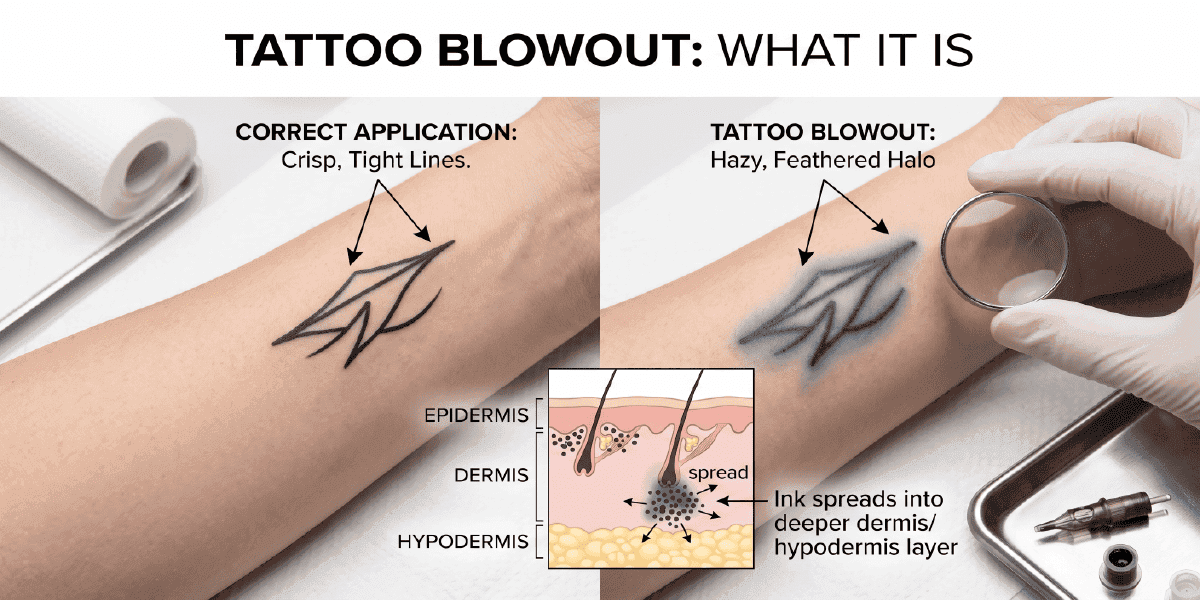
Tattoo ink is deposited into the dermis. Because the dermal structure of a scar is so different, the ink does not distribute and anchor the way it does in orderly normal skin:
- Ink can be absorbed unevenly — held in some areas and lost in others
- Ink can spread beyond where it was placed
- The surface irregularity distorts fine detail and clean lines
### Why Timing Matters For The Same Reasons
A scar continues remodelling for a year or more after the wound closes. Tattooing during active remodelling means depositing ink into tissue whose structure is still shifting.
A line placed on a scar that later flattens or contracts will not stay where it was put.
> "Waiting for full maturity ensures the collagen has finished reorganising — the closest scar tissue comes to behaving predictably under a needle."
### The Keloid Risk
Keloids form when the wound-healing response fails to switch off, overproducing collagen that grows beyond the original injury.
The thousands of micro-punctures a tattoo needle makes are themselves small wounds — and in keloid-prone skin, they can trigger that runaway response all over again.
SHARE THIS
"A scar isn't done healing when the wound closes — it keeps remodelling for a year or more, and tattooing it too soon lets the design distort as it settles."
FROM TATTOOSMAP
Already have your design? Each design in our library includes the recommended aftercare protocol for its specific style and placement. Browse verified designs →
Exactly What To Do, Day by Day
01
WAIT UNTIL THE SCAR IS FULLY MATURE
Give it at least 1 to 2 years, longer for significant scars, until it's flat, pale, soft, and no longer pink, tender, or changing. Tattooing an immature scar risks the design distorting as the tissue settles.
02
GET A MEDICAL OPINION FOR SIGNIFICANT OR KELOID-PRONE SCARS
For surgical, medical, or extensive scars, confirm with a doctor that the tissue is sound. If you form keloids, see a dermatologist first, because the tattooing itself can trigger a new keloid.
03
FIND AN ARTIST WITH SPECIFIC SCAR EXPERIENCE
Ask directly and ask to see healed photos of tattoos over scars, not just their general portfolio. Scar work is a specialist skill, and a general artist doing it occasionally isn't the same thing.
04
CONSULT IN PERSON AND CONSIDER A TEST AREA
Have the artist assess your specific scar before committing, and accept a small test spot if they suggest one, since no one can predict exactly how a scar takes ink until they work on it.
05
CHOOSE A DESIGN THAT WORKS WITH THE SCAR
Favour busy, textured, organic designs that hide irregularity over fine-line or precise geometric work that highlights it, and expect that touch-ups may be needed to even out how the scar holds ink.
What To Never Use
Tattooing a scar before it's fully mature
it's still remodelling for a year or more, so the design can distort as the tissue settles and the unstable skin heals less predictably.
Tattooing over keloid-prone skin without a dermatologist's input
the needle's thousands of micro-wounds can trigger a fresh keloid, potentially leaving you worse off than the original scar.
Choosing a general artist for scar work
scar tissue holds ink unpredictably and needs specialist experience, so judge them on healed photos of actual scar tattoos, not their normal portfolio.
Insisting on fine-line or precise geometric designs over a scar
clean detail highlights the uneven surface, while busy textured designs hide it and hold up far better long-term.
Frequently Asked Questions
Usually yes, once the scar is fully mature — generally at least 1 to 2 years old, flat, pale, and stable. Flat faded scars take ink best, while raised keloids, very thin or shiny scars, and anything still pink or tender are riskier. Because scar tissue holds ink unpredictably, it's specialist work needing an experienced artist.
Wait until it's fully healed and mature, usually at least 1 to 2 years, and longer for significant scars. The scar should be flat, pale, soft, and no longer changing. Tattooing while it's still remodelling risks the design distorting as the tissue settles into its final form.
With real caution, and often it's advised against. Keloid-prone skin can form a new keloid from the tattooing itself, since the needle creates thousands of tiny wounds that can trigger the overactive healing response. If you have a keloid history, see a dermatologist before an artist, and be prepared to be advised against it.
It can feel different — scar tissue has altered nerve supply, so some scars are less sensitive and others more, and the artist often works more slowly and carefully. The experience varies by scar type and location, and a good scar artist will manage the process to keep it tolerable.
Often it can significantly disguise a scar, but results are less predictable than on normal skin, and how well it covers depends on the scar's texture and how it takes ink. Busy textured designs hide scars best. Expect a strong improvement rather than a guaranteed flawless cover, and possibly a touch-up to even things out.
Discussion (0)
Verified Accounts
No public comments yet.
Find Your Artist
Ready To Book?
Browse verified tattoo artists on TattoosMap — filtered by style, city, and specialty.
This is the rule people most want to break and most need to follow: the scar must be fully mature before it's tattooed.
A scar isn't finished healing when the wound closes. It continues remodelling — changing in colour, texture, and firmness — for many months, often over a year or two. Tattooing a scar that's still maturing is a mistake because the tissue is still changing underneath, so the design can distort as the scar settles, and the not-yet-stable tissue is more vulnerable to poor healing.
The general guidance:
Wait at least 1 to 2 years from when the scar formed, longer for significant scars
The scar should be flat, pale, and stable — no longer pink, red, raised, tender, or changing
It should feel settled — soft rather than tight or tender, matching your expectations of how it'll stay
Rushing this is the most common self-inflicted problem in scar tattooing. The scar has waited this long; a few more months of maturity protects the work you're about to invest in.
HONEST LIMITATION
For scars tied to difficult experiences — self-harm, surgery after illness, trauma — the wait can feel cruel, because the whole point is to move past the mark and being told to live with it for another year is hard. That emotional reality is legitimate and worth acknowledging rather than brushing aside with clinical timelines. But the wait genuinely serves you: tattooing an immature scar risks a distorted result that needs correcting, which prolongs the very thing you wanted to resolve. If the mark is emotionally urgent, the kindest realistic path is to use the maturing time to find the right specialist artist and plan the design, so you're ready to go the moment the tissue is.
Why Scar Tissue Is Harder to Tattoo
Understanding why helps you set expectations and choose an artist. Scar tissue simply isn't the same material as normal skin.
When skin heals from a significant wound, the body rebuilds it with collagen laid down in a dense, disorganised pattern, unlike the orderly structure of undamaged skin. That difference changes everything about how it takes ink: the tissue can be denser or thinner, less elastic, differently textured, and with an altered blood supply. Ink deposited into it doesn't sit and settle the same way — it can be absorbed unevenly, held less reliably, or spread unpredictably.
Practically, this means:
The artist often works more slowly and carefully than on normal skin
Multiple sessions and touch-ups are more likely
Certain designs work better than others over scars — texture-hiding styles over fine precise detail
Healing may differ, and the artist should guide aftercare accordingly
This is exactly why scar work is a specialist skill rather than something any competent artist automatically does well.
HONEST LIMITATION
The design has to suit the scar, not just your wish, and a good artist will steer you — which can mean compromising on what you originally pictured. Busy, textured, organic designs (florals, patterns, watercolour, dot work) hide scar irregularity far better than clean fine-line work or precise geometry, which actually highlight the uneven surface. So the ideal design over a scar may not be the one you'd choose on clear skin. That's not the artist being difficult; it's them working with the tissue you have to get you a result that looks good long-term rather than one that fights the scar and loses.
Finding the Right Artist — This Matters Most
Scar tattooing lives and dies on artist skill and experience, more than almost any other tattoo work. The right person makes a hard job look easy; the wrong one turns a fixable scar into a scar plus a bad tattoo.
What to look for:
Specific scar-work experience — ask directly and ask to see healed examples of tattoos over scars, not just their general portfolio
Healed photos, not fresh ones — scar work especially needs to be judged after it settles, since fresh results can look better than the healed reality
Willingness to consult and possibly test — a good scar artist assesses your specific scar in person before committing
Honesty about limitations — the right artist tells you what's realistic, suggests suitable designs, and doesn't overpromise
A clean, professional setup — non-negotiable for any tattoo, and scar tissue's altered healing makes hygiene matter even more
Some scars — particularly medical, surgical, or extensive ones — also warrant a doctor's opinion before tattooing, to confirm the tissue is sound and there's no underlying reason to wait or avoid it.
HONEST LIMITATION
Keloid-prone skin is the one situation where the honest answer leans toward caution or "don't," and it's important not to soften that. If you form keloids — raised, spreading scars that grow beyond the original wound — the tattooing process itself can trigger a fresh keloid, because it's creating thousands of tiny new injuries in keloid-prone skin. That risk is real and can leave you worse off than the scar you started with. If you have a keloid history, this genuinely warrants a conversation with a dermatologist before an artist, and some people are better advised not to tattoo over keloid-prone areas at all. A responsible artist will raise this; if they wave it away, that tells you they're not the specialist you need.
Think of tattooing a scar like painting over a patched, repaired wall rather than fresh plaster. On smooth new plaster, paint goes on evenly and predictably. Over a patch — different texture, different absorbency, maybe a slight ridge — you need a skilled decorator who preps it right, picks a finish that works with the surface, and knows a busy texture hides the repair better than a flat gloss that shows every imperfection. It can look great. But it takes someone who's painted patched walls before, not someone hoping it'll behave like fresh plaster.