Blowout — What It Is, Why It Happens, and What You Can Do
Understand tattoo blowouts: why pigment spreads into the subcutaneous layer, how to spot needle depth issues, and realistic cover-up or laser options.
By TattoosMap Editorial — August 2026
The Short Answer
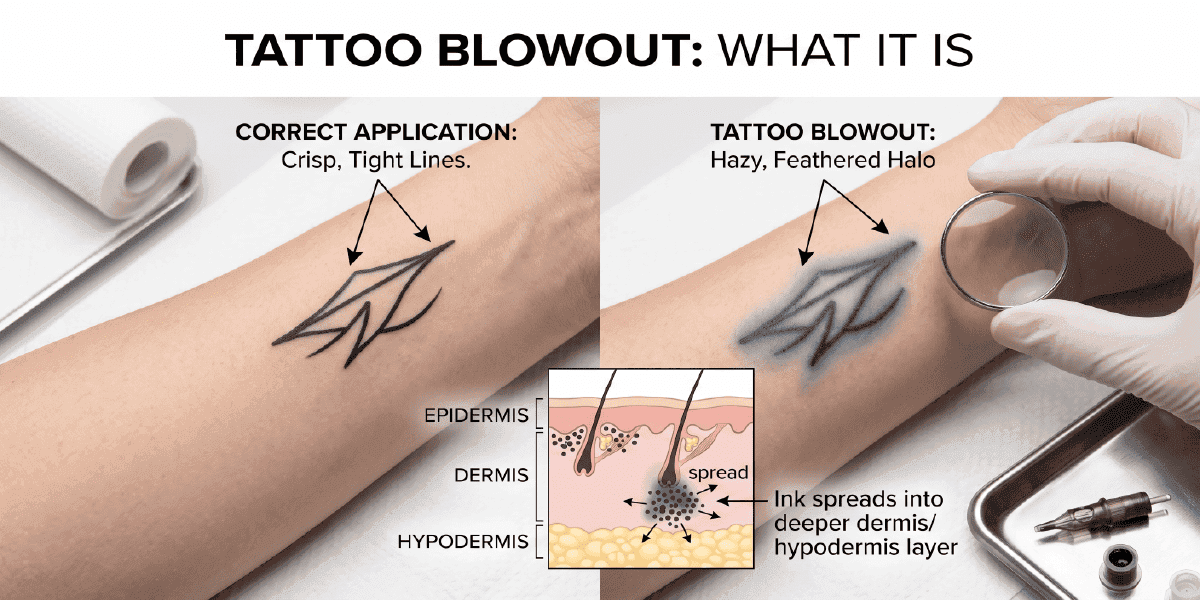
A tattoo blowout is ink spreading out beneath the skin, creating a blurry, smudged, or bruise-like haze around your tattoo lines, caused by the needle depositing ink too deep where it disperses into the layer below. It's an artist error, not an aftercare mistake, and it typically appears within days to a few weeks and won't resolve on its own. Options are limited once it happens — a cover-up, a touch-up to incorporate it, or laser correction — so prevention through a skilled artist is the real answer.
DISCLOSURE: This post contains affiliate links. If you purchase through our links we may earn a small commission at no extra cost to you.
Your crisp new tattoo has a smudgy blue shadow bleeding out from the lines, like ink dropped on wet paper.
That's a blowout, and the first thing worth knowing is that it almost certainly wasn't your fault. The second is what it actually is, and what you can realistically do about it.
What a Blowout Actually Is
A tattoo blowout happens when ink spreads out underneath the skin beyond where it was meant to sit, creating a blurred, hazy, or smudged appearance around the tattoo's lines.
Instead of clean, sharp lines, you get ink bleeding outward into the surrounding skin — often looking like a bruise, a shadow, or a spreading grey-blue haze.
Why It Happens Physically
It happens because the ink was deposited too deep. A tattoo is meant to sit in a specific layer of skin — the dermis.
When the needle goes deeper than that, into the looser tissue below, the ink disperses through that layer and spreads, because there's nothing holding it in a tight line.
Blowouts range from subtle to severe:
Minor — a slight softness or faint haze near some lines, often only you notice
Moderate — visible smudging or shadowing that blurs the design
Severe — significant spreading that distorts the tattoo, hazing well beyond the intended lines
HONEST LIMITATION
A blowout is almost always the artist's error, not something you caused — people often blame their own aftercare and that's misplaced guilt.
Blowouts come from the needle going too deep or at the wrong angle during the tattooing itself — a technique issue that happens in the chair, before you ever started healing.
"Your aftercare didn't cause it and, honestly, couldn't have prevented it."
Understanding this matters both so you don't blame yourself and so you know that choosing a skilled artist, not perfect aftercare, is what actually prevents blowouts.
Why Blowouts Happen
Understanding the causes helps you both recognise what went wrong and avoid it next time. Nearly all of them trace back to depth and technique:
WHY DEPTH DETERMINES WHETHER INK STAYS SHARP
A clean tattoo depends on ink being placed in one specific layer of skin, and a blowout is what happens when it lands in the wrong one. The target is the dermis — the stable, structured middle layer of skin — and it's the correct depth for a precise reason: the dermis holds ink in place. Its dense network of collagen and connective tissue locks the pigment particles where they're deposited, keeping lines crisp and preventing the ink from migrating, which is exactly why tattoos in the dermis stay sharp and permanent. Above the dermis is the epidermis, which sheds and renews, so ink there would simply flake away. Below it is the subcutaneous layer, made of loose connective tissue and fat with far less structure to contain anything. When the needle goes too deep and deposits ink into this subcutaneous layer, there's nothing to hold the pigment in a tight line — it disperses through the loose tissue and spreads outward from where it was placed, and that spread, seen through the skin, is the hazy, smudged shadow of a blowout. This is why a blowout is fundamentally a depth-control problem and why it can't be fixed with aftercare. The moment ink is deposited too deep, it begins dispersing through tissue that can't contain it, and that dispersal is essentially immediate and permanent — the spread has already happened by the time you leave the chair, even if swelling hides it for a few days. It also explains why thin-skinned areas like fingers, wrists, and ankles blow out more easily: the dermis is thinner there, so the correct depth window is narrower and the margin between "in the dermis" and "too deep" is smaller, leaving less room for any error in the artist's hand. Correcting a blowout is difficult for the same structural reason it happened: the ink is now distributed through loose subcutaneous tissue rather than sitting in a defined line, so a rework can't gather it back, and only laser — which breaks the dispersed pigment into fragments the body clears — can actually remove the misplaced ink. The whole phenomenon comes down to a few tenths of a millimetre of depth, which is why consistent depth control is one of the defining skills that separates an experienced tattoo artist from a novice.
SHARE THIS
"A blowout is decided by the hand holding the needle, not by how you healed it — your aftercare didn't cause it and couldn't have prevented it."
FROM TATTOOSMAP
Already have your design? Each design in our library includes the recommended aftercare protocol for its specific style and placement. Browse verified designs →
Exactly What To Do, Day by Day
01
WAIT OUT THE HEALING PROCESS BEFORE JUDGING
A new tattoo often looks hazy while healing. Give it a full 4 to 6 weeks to heal completely before deciding if it's a genuine blowout or just normal healing fluid and swelling.
02
DO NOT TREAT IT LIKE AN INFECTION
A blowout is simply ink that has spread too deep into the fat layer. It is not an infection. Do not apply antibiotic ointments or harsh chemicals trying to 'draw the ink out'.
03
CONSIDER TARGETED LASER REMOVAL
A skilled laser technician using a Q-switched or Pico laser can often trace the blowout haze and remove it without destroying the original crisp linework of your tattoo.
04
EXPLORE CREATIVE CAMOUFLAGE OR SHADING
Consult a highly experienced artist. They can often add background shading, color, or thicker linework to successfully mask the blown-out edges.
05
AVOID AT-HOME FIXES ENTIRELY
Never attempt to scrub, peel, burn, or use 'tattoo removal creams' to fix a blowout. You will only cause permanent scarring and make the situation far worse.
What To Never Use
Blaming your aftercare for a blowout
it's caused by the needle going too deep during tattooing, a technique error that happens in the chair, so no aftercare could have prevented it.
Judging or trying to fix a blowout before the tattoo fully heals
early swelling and bruising mimic ink spread and sometimes settle into a clean tattoo, so wait the full 3 to 4 weeks before concluding.
Trying creams or home remedies to remove a blowout
the ink has already dispersed through tissue and only genuine correction like laser, cover-up, or rework addresses it.
Choosing a cheap or inexperienced artist for thin-skinned placements
fingers, wrists, and ankles have a narrow depth window, so fine-line work there is exactly where blowouts happen and where artist skill matters most.
Frequently Asked Questions
It's when ink spreads out beneath the skin beyond the intended lines, creating a blurry, smudged, or bruise-like haze around the tattoo. It happens because the needle deposited ink too deep, into the loose layer below the dermis, where the ink disperses instead of staying in a crisp line. It's an artist technique error, not an aftercare mistake.
Almost always the needle going too deep, past the dermis into the subcutaneous layer where ink spreads. Contributing factors include wrong needle angle, too much pressure, inexperience, and thin-skinned placements like fingers and wrists that have a narrower margin for depth error. It's a technique issue that happens during tattooing.
No, not fully. Minor blowouts sometimes become slightly less noticeable as the ink disperses a little over months, but the spread ink is in your skin and won't simply vanish. Fixes are limited to living with it, a cover-up or rework, or laser correction — creams and home remedies don't work.
Time is the key. Normal healing involves temporary bruising and blurriness that improves and sharpens over 2 to 4 weeks, while a blowout is ink spread that persists or becomes clearer once swelling settles. Wait out the full healing before concluding — if hazy spread beyond the lines remains at 3 to 4 weeks, it's likely a blowout.
Partially. Options are a cover-up or rework that incorporates the blown-out area, laser removal or lightening of the spread ink, or a touch-up of the lines — but none fully restores the original crisp design. This is why prevention through a skilled artist matters far more than correction. A consultation with an experienced artist or laser clinic gives you honest options.
Discussion (0)
Verified Accounts
No public comments yet.
Find Your Artist
Ready To Book?
Browse verified tattoo artists on TattoosMap — filtered by style, city, and specialty.
Going too deep — the core cause; past the dermis into the subcutaneous layer, ink disperses
Wrong needle angle — too shallow or inconsistent an angle drives ink sideways under the skin
Too much pressure — pressing too hard pushes the needle deeper than intended
Inexperience — depth control is one of the hardest things for a new artist to master consistently
Thin or delicate skin — inner wrist, fingers, ankles, feet, and inner arm have less margin for error
HONEST LIMITATION
While blowouts are overwhelmingly a technique issue, certain placements genuinely carry higher risk even for good artists, so location plays an honest supporting role.
Fingers, wrists, ankles, and other thin-skinned areas are less forgiving of any depth error, which is part of why fine-line tattoos in these spots blow out more often.
This doesn't shift the blame to you — a skilled artist knows these areas demand extra care and adjusts. But it does mean choosing a delicate design in a high-risk spot raises the stakes on picking a genuinely experienced artist.
Blowout vs Normal Healing
People sometimes panic at normal healing signs or, conversely, dismiss an early blowout as healing. Here's the distinction.
Normal Healing Can Involve
Redness, swelling, and bruising around the tattoo in the first days
Some temporary blurriness or haziness while inflamed and healing
Steady improvement as swelling subsides and skin settles
The tattoo sharpening up as it heals over 2 to 4 weeks
A Blowout Shows As
Ink spread that persists or becomes clearer as healing progresses
A defined haze, shadow, or smudge beyond the lines that doesn't resolve
Blurring that remains once swelling has fully settled
Often visible within days but confirmed as the tattoo finishes healing
The key is time. Normal healing improves and sharpens, while a blowout remains or becomes more obvious once everything settles.
"Give it the full healing period before concluding — but if hazy spread is still there at 3 to 4 weeks, that's likely what it is."
HONEST LIMITATION
It's genuinely hard to be certain a blowout has happened until the tattoo has fully healed, and that waiting period is real and frustrating.
Early swelling, bruising, and inflammation can look alarming and mimic ink spread, so what appears to be a blowout in week one occasionally settles into a clean tattoo by week four.
The honest advice is to wait out the full healing before judging or acting. You can't reliably fix or even confirm a blowout on a still-healing tattoo, and acting too early risks treating a problem that would have resolved.
Can a Blowout Be Fixed?
This is the hard part, and honesty matters more than reassurance. Once a blowout has healed, it doesn't go away on its own, and the fixes are limited.
Realistic options:
Wait and assess — minor blowouts sometimes become less noticeable over months, and you may decide to live with them
A cover-up or rework — a skilled artist can incorporate the blown-out area into a redesigned or expanded tattoo, often the most practical fix for moderate blowouts
Laser removal or lightening — laser breaks down the spread ink, either to lighten it for a cleaner rework or remove the area, the most effective correction for the misplaced ink itself
Touch-up by a skilled artist — careful reworking of the lines can improve appearance, though it can't remove ink that's already spread
What won't work: creams, home remedies, or waiting indefinitely for it to vanish. The spread ink is in your skin and only genuine correction addresses it.
HONEST LIMITATION
A blowout can't simply be undone, and every fix has trade-offs, so it's better to know that than to be sold false hope.
A cover-up means a different, usually larger tattoo than you planned; laser means time, cost, and a correction process; living with it means accepting the imperfection. None of these restores the crisp original design you wanted.
"A blowout is far easier to avoid than to fix — which is the strongest argument for investing in a skilled artist upfront."
If you have a blowout, a consultation with an experienced artist or a reputable laser clinic is the realistic path, and they'll give you honest options rather than a magic fix.
How to Avoid a Blowout
Since correction is limited, prevention is the real answer, and most of it comes down to the artist:
Choose an experienced, skilled artist — depth control is the core skill that prevents blowouts, judged on a strong portfolio of clean, sharp healed work
Look at healed photos, not fresh ones — fresh tattoos look crisp before any blowout appears
Be cautious with thin-skinned placements — for fingers, wrists, ankles, and fine-line work, artist skill matters even more
Read reviews and ask about blowouts specifically if you're getting a high-risk placement
Don't choose on price for tricky work — a cheap artist on a delicate fine-line wrist tattoo is exactly where blowouts happen
Your aftercare doesn't prevent blowouts, but good aftercare still matters for everything else — healing, infection, and how sharp the final result looks.
HONEST LIMITATION
Even excellent artists very occasionally get a blowout, particularly in high-risk areas, so choosing well reduces the risk substantially but can't guarantee zero.
Skin varies, thin-skinned spots are unforgiving, and no one has a perfect record on every placement forever.
That said, the difference between a skilled artist and an inexperienced one is enormous — the vast majority of blowouts are preventable technique errors. Choosing carefully moves you from "likely" to "unlikely," which is the most control you realistically have.
Think of ink placement like planting seeds at the right depth. Plant them in the correct shallow layer and they grow exactly where you put them, in neat rows.
Push them too deep into loose soil and they scatter and spread, coming up as a blurry patch instead of a clean line — and once they've spread, you can't gather them back up. The gardener's skill is in the depth, every single time, and that's what separates a crisp tattoo from a blown-out one. It was decided by the hand holding the needle, not by how you tended it afterward.