Related Studio & Technical Guides
- Needle Configuration: Understand taper & groupings in our Best Tattoo Needles Guide.
- Machine Setup: Compare starter rotary options in our Best Tattoo Machine for Beginners Guide.
- Hygiene Standards: Review barrier controls in our Best Tattoo Grip & Supply Guide.
The Ranked List
DISCLOSURE: This post contains affiliate links. If you purchase through our links we may earn a small commission at no extra cost to you.
Dynamic Black Tattoo Ink
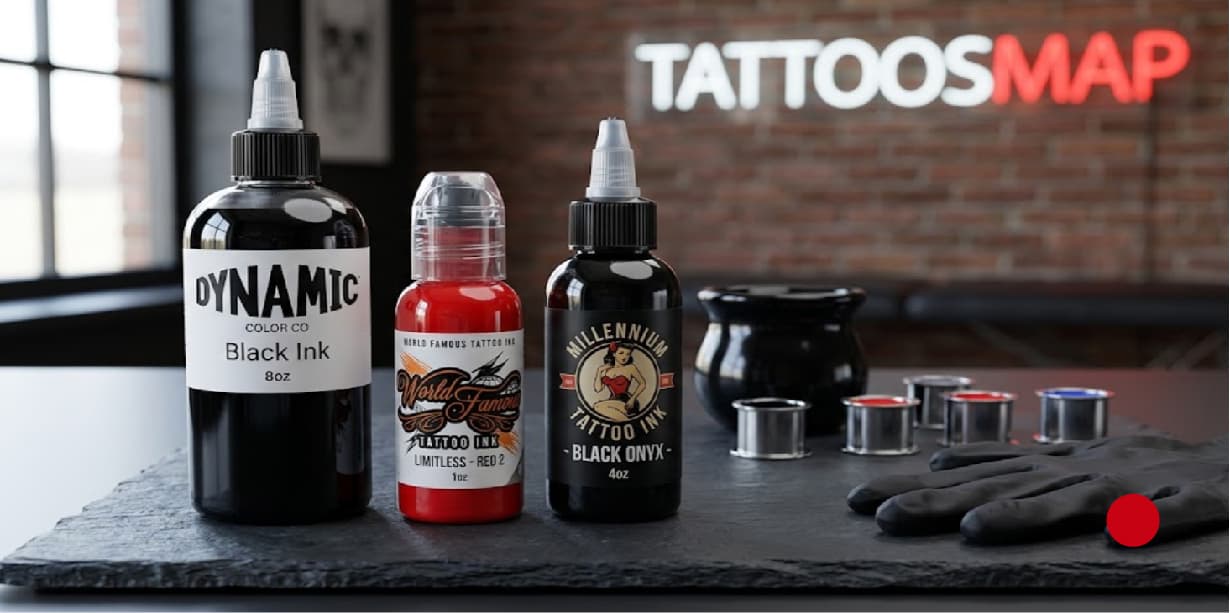
BEST OVERALL BLACK INKThe 8oz bottle in the white label with black text. This is the ink in more professional shops than any other black. The viscosity is tuned for lining — it flows clean at normal machine speeds without being so thin it bleeds. Heals consistently dark with minimal greying in the first year. Most artists who switch away from Dynamic Black come back to it.
Dynamic Black is a lining ink, not a shading ink — it is too dense for grey wash work without significant dilution, and the dilution ratios take experimentation to get right for your technique.
Eternal Ink — Color Set
BEST COLOR INK FOR HEALINGThe carrier solution in Eternal heals cleaner than any other color ink most artists have used — less redness, less plasma weeping, faster surface resolution. The colors sit true after healing rather than shifting significantly toward the yellow-green the skin naturally adds to everything. The price per bottle is higher than alternatives but the heal quality justifies it for client-facing work.
Why Pigment Particle Size Controls Both Color and Migration
Tattoo ink sits in the dermis — the second layer of skin, below the epidermis that sheds and renews every few weeks. The particles need to be large enough that macrophages, the cleanup cells in the immune system, cannot carry them to the lymph nodes, but small enough to pass through a needle and sit cleanly in the dermal layer without spreading. This is the particle size balance that determines whether ink migrates. Too-small particles get engulfed and cleared, causing fading. Too-large particles spread through dermal tissue, causing blurring. Premium inks calibrate particle size within a specific range through milling — grinding the pigment until particles are consistently sized. Budget inks have inconsistent particle distribution, which is why they can look sharp immediately after application and spread within two years. The color you see is determined by which wavelengths of light the pigment absorbs and reflects — red pigment absorbs green and blue light and reflects red. When UV radiation breaks down the molecular structure of the pigment compound the absorption spectrum shifts, which is why colors change over time rather than simply disappearing.
"The ink brand extends the lifespan of a well-executed tattoo. It cannot save a poorly placed one — and no manufacturer will tell you that."
Already have your design? Each design in our library includes the recommended aftercare protocol for its specific style and placement. Browse verified designs →
Exactly What To Do, Day by Day
PIGMENT CHECK
Look for manufacturing date and batch number on every bottle. Don't use expired ink. Carrier fluids degrade and lose sterility.
MIXING TECHNIQUE
Run an electric pigment mixer for 10 seconds before pouring. Pigment settles at the bottom. Skip this and you'll get inconsistent saturation.
CAP HYGIENE
Never dip directly into the main bottle. Pour into sterile caps. Throw away excess after each session. No exceptions.
DEPTH PRECISION
Carbon-heavy inks need to sit in the upper dermis. Go too deep and you get blue-tinted shadows from light scattering.
UV PROTECTION
Full color stability doesn't exist without sun protection. Tell your clients to use mineral SPF. It's the only way to prevent molecular breakdown.
What To Never Use
Budget ink sets under $20 for a full color range
Inconsistent particle size distribution causes migration and color shift within two years — the price difference between budget and professional ink is $50 per set, which is negligible against the cost of a client dissatisfied with their tattoo in year three
White ink on clients without warning them
Titanium dioxide white fades faster than any other pigment on the majority of skin tones and yellows significantly on some — have the conversation before the appointment not after
Sharing ink cups between clients
Cross-contamination is not a theoretical risk — bloodborne pathogens can survive in ink and the consequences for both client and artist are severe
Mixing inks from different brands
Incompatible carrier solutions can cause separation, inconsistent flow, and undermines the sterility testing that each brand conducts independently